Auctorial influence is a tricky thing, even for those writers whose style or choice of subject is consciously patterned (admittedly or otherwise) after another writer’s work.

Rex Stout circa 1969 /photo Bruce Davidson
When confronted with the question of influence, I usually mention Nelson DeMille, because it was his John Corey novels, beginning with Plum Island, that convinced me both that I wanted to write crime fiction, and that I could probably do so with some degree of proficiency.
But if you were to take a tissue sample of my writing and centrifuge it and place it under a microscope, I suspect the DNA would match to an earlier point in the crime fiction genome. To my teens, in fact, when I read, if not all, then certainly a majority of the fifty or so Nero Wolfe detective novels authored by mystery grand-master Rex Stout.
Stout—who was then still actively writing—was the first “series author” whose canon I had encountered, such that the thrill of reading one book was heightened by the knowledge that dozens more awaited. And while most of those books came from the public library, Stout’s were the first dime-store paperbacks (fifty cents at the time) that I actually purchased with my own paper-route money, placing his work on a lofty pedestal alongside Spider-Man, wax lips, and Drake’s Ring Dings.
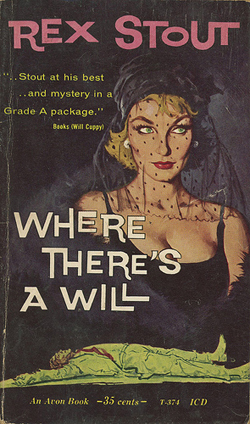
Where there’s a will, there’s a woman.
The Nero Wolf books were a revelation: compact tales of crime and punishment starring a corpulent, agoraphobic gourmand and orchid fancier whose formidable (and unabashedly Sherlockian) powers of deduction were wielded from behind a desk in his brownstone on West 35th Street with the aid of a two-fisted Boswell named Archie Goodwin. More than mere page-turning entertainment, the books were erudite, and slyly political, and sometimes touched on hot-button social issues like Communism (The Second Confession, 1949), and civil rights (A Right to Die, 1964), and governmental intrusion (The Doorbell Rang, 1965).
Rex Stout wrote over 70 Nero Wolfe novels, novellas, and short stories over the course of an unusually prolific writing career that stretched from pre-World War II (Fer-de-Lance, 1934) to post-Vietnam (A Family Affair, 1975). Politically progressive, he was a founding member of the American Civil Liberties Union who famously ignored a subpoena from Joseph McCarthy’s House Un-American Activities Committee. Commercially successful (“no man but a blockhead ever wrote except for money”), Stout commanded a worldwide audience that included the Belgian surrealist René Magritte, who named several of his paintings after Nero Wolfe novels.
Between 1934 and 1966, Stout consistently published two to four Nero Wolfe novels, novellas or short stories per year—a prodigious output for most writers working full-time. Only Stout didn’t work full-time. “I work for 39 consecutive days each year,” he is quoted in his New York Times obituary. “I figure on six weeks for a book, but I shave it down.”
I can recall as a teenager seeing Stout interviewed on television. I believe the show was called Book Beat. In explaining his literary fecundity, Stout described his writing routine as follows (and I’m paraphrasing here): “I start typing on page one and I don’t stop until I get to the end. And then I’m done. I never go back and change a word.”
In the summer of 1970—my fifteenth year, Stout’s eighty-fourth—I had an attenuated encounter with my literary hero. It all began at a backyard barbeque at my family home in Levittown, New York, where an uncle down from Brewster noticed me reading a Nero Wolfe novel.
“You like him?” my uncle asked me.
“He’s the best,” I replied, or words to that effect.
“He’s my neighbor. Would you like his autograph?”
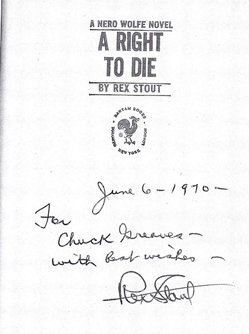
A true prize.
The paperback I’d been reading was the aforementioned A Right to Die, which I dubiously surrendered on the spot. Two weeks later, it returned in the afternoon mail. “To Chuck Greaves—with best wishes—Rex Stout,” read the inscription, dated June 6, 1970. I was thrilled, of course, and today that book still reposes on my Shelf of Honor, the dean of a mottled college of autographed tomes spanning some forty years of collecting.
What writers have influenced my work? The answer, naturally, is all of them. In some cases the influence is both proximate and obvious, while in others it is so subtle as to be unconscious. But perhaps it is Rex Stout who—like his “one-seventh of a ton” alter ego—looms largest of them all.
Rex Stout image via NeroWolfe.org
Written by : Chuck Greaves

The author of seven novels, Chuck Greaves has been a finalist for many of the top honors in crime fiction including the Shamus, Lefty, Macavity, and Audie Awards, as well as the New Mexico-Arizona, Oklahoma, and Colorado Book Awards and the Harper Lee Prize for Legal Fiction. His 2012 novel Hard Twisted (Bloomsbury) was hailed by the Los Angeles Times as “a gritty, gripping read, and one that begs to be put on film,” while his 2015 novel Tom & Lucky (Bloomsbury) was a Wall Street Journal “Ten Best Mysteries of 2015” selection. His latest novel The Chimera Club, the fourth installment in his critically acclaimed Jack MacTaggart series of legal mysteries (Minotaur), was a 2023 Colorado Book Award finalist and won the Colorado Authors League award for the Best Mystery Novel of 2022.

Pause for Poetry
Pause for Poetry features poems read by poets whose work appears in Four Corners Voices volumes 1 & 2. The podcast is produced in association with KSJD.
Theme music by John Melnick and the Song Studio.
Subscribe To Our Newsletter
BE NOTIFIED ABOUT OUR WORKSHOPS, EVENTS, AND OTHER ANNOUNCEMENTS
We will not sell your information.
Support Four Corners Writers
Your tax-deductible gifts support our mission to identify, develop, and promote literary voices in the American Southwest.